

Rethinking the Curriculum: If We’re Serious About Reducing NEET, Engagement Must Come First
Recent DfE analysis on young people becoming NEET delivers a clear message:
Risk factors for becoming NEET: a statistical analysis using linked data - GOV.UK
Disengagement isn’t a symptom – it’s an early warning sign.
We often focus on the headline indicators:
- Persistent absence
- Low GCSE attainment
- SEND (particularly EHCP)
And rightly so.
For example:
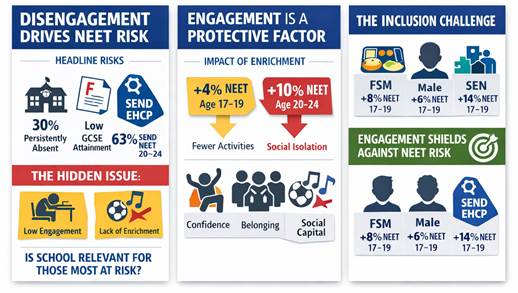
- 63% of young people with an EHCP were NEET between ages 20–24, compared to 28% without
- 30% of persistently absent KS4 pupils became NEET at 17–19
- Failing to achieve Grade 4+ in English and Maths increases NEET risk by 5–7 percentage points, even after other factors are controlled
These are not marginal effects—they are system-defining risks.
The hidden issue: relevance, not just rigour
But the deeper story is more uncomfortable.
Young people who become NEET are far more likely to have experienced:
- Low engagement with school
- Limited participation in enrichment or social activity
And this compounds quickly:
- Young people with fewer than 3 risk factors: ~20% NEET
- Young people with 10+ risk factors: ~53% NEET
This tells us something critical:
NEET is not caused by a single issue—it is the result of accumulated disengagement.
So the question we need to ask is simple:
Is the curriculum genuinely engaging for the students who need it most?
Engagement is not “soft”—it’s protective
The report highlights a powerful shift in understanding:
Not taking part in enrichment activities increases NEET risk by:
- +4 percentage points at 17–19
- +10 percentage points by age 20–24
In other words, the absence of engagement becomes more damaging over time.
Why?
Because these experiences build:
- Confidence
- Social capital
- Belonging
- Employability skills
Without them, young people are more likely to experience:
- Isolation
- Lower aspirations
- Weaker transitions into employment
Engagement is not an add-on. It is a protective factor.
The inclusion reality
The data also reinforces inequity:
- FSM pupils are 8 percentage points more likely to be NEET at 17–19
- SEN pupils are 14 percentage points more likely
- Boys are 6 percentage points more likely than girls
But the reasons differ:
- FSM → more risk factors
- Male → more vulnerable to risk factors
- SEN → both more exposure and greater vulnerability
This matters, because it means a one-size-fits-all curriculum will not close these gaps.
So what needs to change?
If we are serious about reducing NEET, interventions alone are not enough.
We need to rethink the core experience of school.
1. Broaden what success looks like
Low GCSE attainment remains one of the most widespread risk factors.
But when success is narrowly defined:
- those who struggle disengage earlier
- absence rises
- risk accumulates
2. Make learning more applied
Persistent absence has risen sharply:
- From 8% in this study cohort to ~26–27% in recent KS4 data
This is not just a behaviour issue.
It is a signal.
Learning must feel:
- relevant
- practical
- connected to future pathways
I have seen examples in Germany and Singapore of students engaged in real business which is very motivating for them. Often colleges do this work post 16 but we need more from 11.
3. Treat enrichment as essential
The evidence is clear:
Lack of participation becomes one of the strongest predictors by early adulthood
This should fundamentally shift how we see:
- outdoor learning
- sport
- arts
- youth programmes
Not as enrichment—but as core curriculum.
4. Strengthen SEND pathways
EHCP remains the single strongest predictor of NEET risk.
And as EHCP prevalence rises (now over 5% nationally), the system challenge grows.
We need earlier focus on:
- independence
- employment pathways
- preparation for adulthood
5. Track engagement like attainment
If engagement predicts NEET, we should measure it.
Because currently:
- we systematically track grades
- we track attendance
- but we rarely track engagement itself
The leadership challenge
We cannot “intervene” our way out of NEET risk if the everyday experience of school is disengaging.
Because the data tells us:
- Risk builds
- It compounds
- And by KS4, it is often already entrenched
Final thought
The most effective NEET strategy is not what happens at 16.
It’s what young people experience at 11, 13 and 14.
Because when young people:
- feel engaged
- experience success
- build confidence
They are far less likely to become NEET.
Question for leaders:
Are we designing a curriculum that protects against NEET—or one that unintentionally contributes to it?