
Why ICFP Doesn’t Work for Special Schools and SRBs – and why it matters!
Integrated Curriculum and Financial Planning (ICFP) has become one of the most widely adopted tools in school financial management.
In mainstream settings, it works well.
It aligns curriculum delivery, staffing deployment, and budget planning in a clear and structured way.
But in special schools and Specialist Resource Bases (SRBs), something important happens:
The model breaks.
And unless we understand why, we risk making the wrong decisions—at school, trust and system level.
The Assumption Problem
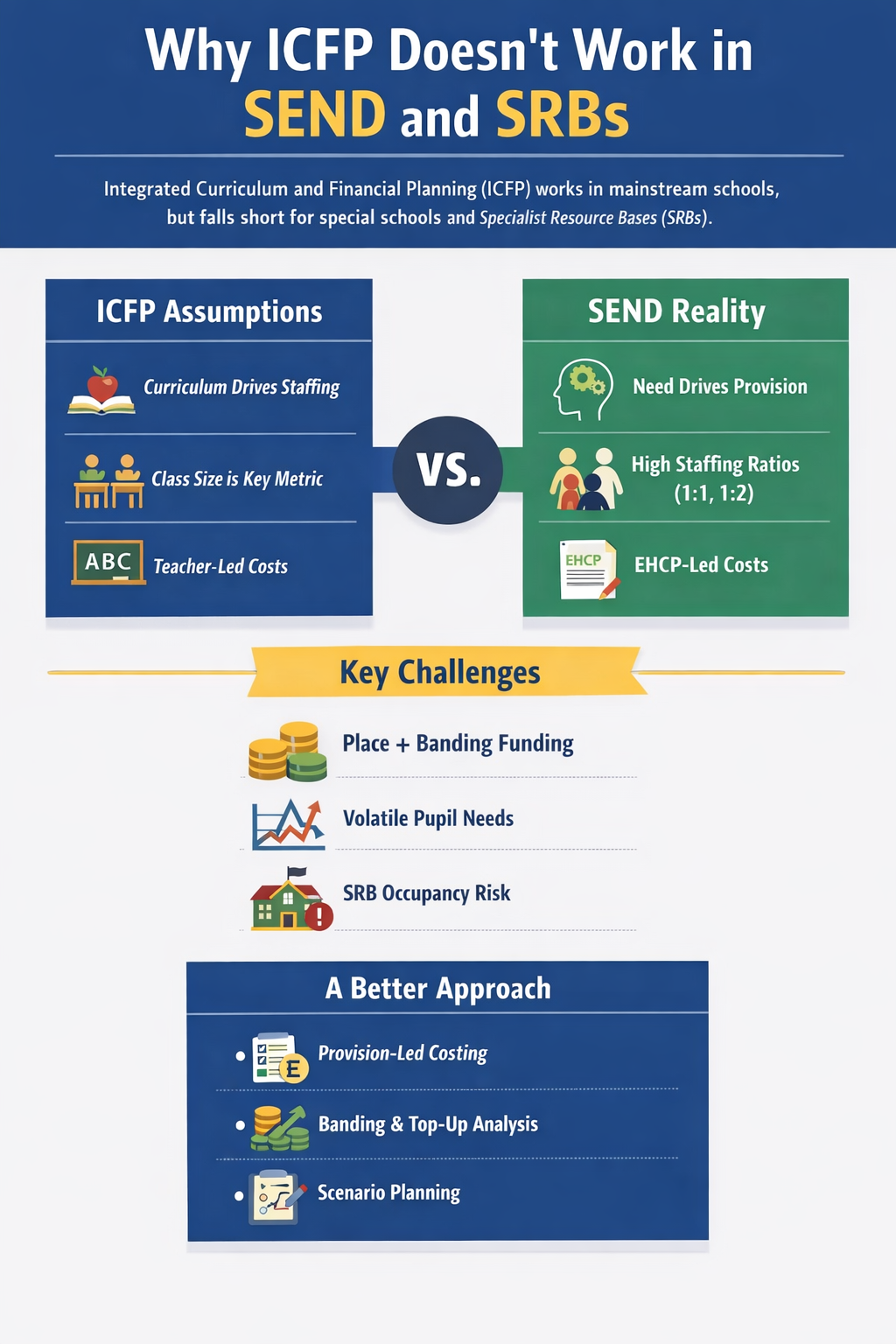
ICFP is built on three core assumptions:
- Curriculum drives staffing
- Class size is a key efficiency metric
- Teachers are the main cost driver
These assumptions make sense in mainstream education.
But in SEND?
They simply don’t hold.
SEND Works Differently
In special schools and SRBs:
- Need drives provision (not curriculum)
- EHCPs define staffing (not timetables)
- Staffing ratios are high and often fixed (1:1, 1:2)
- Support staff dominate cost, not teachers
This flips the entire model:
In mainstream → curriculum → staffing → cost
In SEND → need → staffing → cost
That one shift changes everything.
The Funding Reality
SEND operates on a place-plus funding model:
- ~£10,000 per place
- top-up funding linked to need (banding)
This means:
- Income is driven by individual pupil complexity
- Not just total pupil numbers
ICFP doesn’t capture this dynamic well.
So what happens?
- Models suggest efficiency issues
- When the reality is structural funding mismatch
Where This Becomes Critical: SRBs
Specialist Resource Bases amplify every weakness in traditional modelling.
They are:
- small-scale (often 12–20 places)
- high-cost (staffing heavy)
- dependent on LA commissioning
- vulnerable to low occupancy in early years
This creates a harsh truth:
An SRB can be well-run, well-led, and still not financially viable.
The Risk for Leaders and Trustees
When ICFP is applied without adaptation, it can lead to:
- Misdiagnosing structural deficits as inefficiency
- Using the wrong metrics (class size, PTR)
- Poor decision-making on expansion or provision
- Underestimating SRB risk
At governance level, this is significant.
Because it shifts the narrative from:
“We are inefficient”
To the real question: “Is this provision fundable within the current system?”
A Better Way Forward
Financial planning in SEND needs to reflect reality.
That means moving toward:
1. Provision-led costing
Start with: need → staffing → cost Not the other way round.
2. Banding-informed income modelling
Understand:
- how funding varies by need
- how band distribution affects viability
3. Scenario planning
Model:
- occupancy changes
- demand growth
- funding pressures
4. The right metrics
Focus on:
- cost per pupil
- adults per pupil
- funding gap
Not: class size
The Key Insight
ICFP is not wrong.
It’s just: A model designed for mainstream education being applied to a fundamentally different system.
Final Thought
For leaders, trustees and system planners, this matters more than ever.
- Demand is rising.
- High needs budgets are under pressure.
- SRBs and specialist provision are expanding rapidly.
So the real question is no longer:
“Are we using ICFP well?”
It is:
“Are we using the right model for the reality of SEND?”